Sunday, 24 February 2013

Production and Distribution Companies


Production and Distribution Companies


A Production Company is generally involved in producing either recorded or live entertainment or its the type of company thats involved in funding, helping to facilitate the making of films or Tv shows. It most often provides the money for the making and distributing. The production company may be directly responsible for fundraising for the production or may accomplish this through a parent company, partner, or private investor. They handle budgeting, scheduling, scripting, the supply with talent and resources, the organization of staff, the production itself, post-production, distribution, and marketing.
Production companies are often either owned or under contract with a media conglomerate, film studio, entertainment company, or Motion Picture Company, who act as the production company's partner or parent company. This has become known as the "studio system". Production companies can work together in co-productions.


Well known Gangster Film Porduction Companies:

Warner Bros. - Goodfellas, Bonnie and Clyde
Dark Castle/Studio Canal - Rock n Rolla
Paramount Pictures - The Godfather Triology
Working Title/Universal - American Gangster


Universal is an American motion picture studio, owned by Comcast. We decided to use Universal as our Production company logo, as it has produced and distributed lots of gangster films like ours.


A Film Distribution Company is a company or individual responsible for the marketing of a film. The distributor may set the release date of a film and the method by which a film is to be exhibited or made available for viewing: for example, directly to the public either theatrically or for home viewing A distributor may do this directly, if the distributor owns the theaters or film distribution networks, or through theatrical exhibitors and other sub-distributors. A limited distributor may deal only with particular products, such as DVDs or Blu-ray, or may act in a particular country or market.


Well known Gangster Film Distributors:

Warner Bros. - Goodfellas, The Departed, Once Apon A Time In America
Paramount Pictures - The Godfather I, II and III
Universal - Scarface, Carlito's Way, Casino
Tri Star - Donnie Brasco


Paramount Pictures Corporation is a film and television production/distribution studio, consistently ranked as one of the largest (top-grossing) movie studios. It also owns Paramount Pictures which is one of the leading independent motion pictures distributors. Its most successful films were Kung Fu Panda, Iron Man and Titanic.

Mood Board


Gangster Board

Public Enemies Opening Analysis

Public Enemies
 
 
Mise-en scene: The clothing is in the style of 1930's, as that when the film is set. In the beginning we see John Dillenger dressed smartly, in a tie and waistcoat with a thick overcoat on. The policeman taking John to the Prison was wearing the same as John, but all black, he also had on a police badge. In the prison, Johns crew are prisoner, so are wearing thr regulatory black and white jumpsuit. The Prison officers were wearing navy uniforms with hats and batons. The woman at the farm, was wearing dull, worn clothing, indicating they were not well off, as you could see from the state the farm was in, she wore a green dress and baby blue apron with a brown shawl, the child with her was wearing dungarees. The next scene shows a man in a blue suit, white shirt, carrying a tommy gun, being chased by a federal detective who's dressed in hunting clothes, a grey shirt, beige trousers with suspenders and brown leather boots. In contrast with the woman at the farm earlier, the women at John's house wore much less bestraggled clothing, a black dress with white spots, perfectly fitting in with the steriotypical sthugh of style of the 1930's. Overall the men are in predominantly dark simply tailored suits, we know later in the film, the women are dressed in lavish dresses of bright colours, to show off wealth. The obvious props used were the guns: tommy guns, hunting rifles, machine guns and hand guns and then men wear trilby hats.


Editing:  They use jump cuts and cross-cuts between scenes to cut from one lot of action to the next. In the scenes they used normal cuts to emphasize different people and characters. Also to show different points of view. When the characters are speaking to eachother they use shot/reverse/shot. They also use lots of match on action e.g when the gang is leaving the farm house, then when they are outside heading toward the car.
 
Sound: Apart from the stomping of feet in the opening and gunfire and talking, the only other sound in the opening of the film is the song 'Ten Million Slaves' by Otis Taylor.
 

Lighting: In the beginning of the film the charcters are mostly outside so the lighting is natural , even when they are in the farm house the light's comming from outside, also in John's house, but when the characters are in the prison, that could bethe only time that they use artificial lighting, however the prision is quite dark, probably to portray it being a bad place, so it too may have used natural lighting.
 
Camera Shots: In the first minute the film opens with a shot of the prisoners feet marching, telling us right away by what they are wearing that this is a prison, also by the chains around their feet. Theres then an over the sholder shot of the prisoners and a close up of a guard watching them, there's then a long shot of a prisoner lying dead on the ground. There is then a long eye level shot of the prisoners walking toward the camera. And then an extreme close up of a prisoners hand on another prisoners arm as they walk. After that there's a pan of a car driving, signalling the end of the prisoner scene.


Poster Analysis

Poster Analysis
 

The Goodfellas poster shows the characters above the city, which implies that thay are above the city/law and public, and that they own the city.

Also they seem to be comming out of the dark or shadows, which may indicate the fact that they have a dark side or dark past, which is helped by the fact that they are standing above a dead man, which could say they killed him and are watching him die.

All the men are wearing black suits with a white shirt, but Robert De Niroid also wearing a red tie, which could show he's the boss of the other two, also the fact that he's in the middle and that his name is above the other two men's. The red tie is also associated with danger and blood or the sheading of blood, death.

Without watching the film, you can tell about when it's set via the title's writing and the street background, being old style. You can also see the cars in the background wich are fromaround the 1950's.


Lock, Stock and Two Smoking Barrels Soundtrack analysis

 Soundtrack Analysis

The film Lock, Stock and Two Smoking Barrels, classed an an oddity to many people and the sountrack is no exception through its score and pop songs its seen as rather unconventional, though it largely consists of Vintage Punk Rock, R&B and Reggae, it also has Dusty Sprigfields "Spooky", which are fitting in their proper moments in the film. The songs are interspersed with snippets of diaglogue from the filmthat indicate its sarcastic, low-life nature. The sountrack compliments the cinematography, the music works with the cuts,shot and slow motion in the film, by giving the sense that camera is changing to fit the environment, pace and mood by adjusting its focus.


In this scene we see the music start as the man is trying more urgently to sell his products, as soon as the man tell him the police are comming, the music takes on a higher pitch and become quicker, matching the men packing up their good, and running off. The music then takes on a rock quality as the men are racing away from the cops and dodging obsticals. When the men go into slow motion, the music gets dimmed as a male voice talks over it, then louder as the men drop their package, then again louder and quicker as they leave the suitcase behind and sprint off. This is one example of the music fitting with the slow motion, pace and mood.


The Departed Frame Board


Frame Board


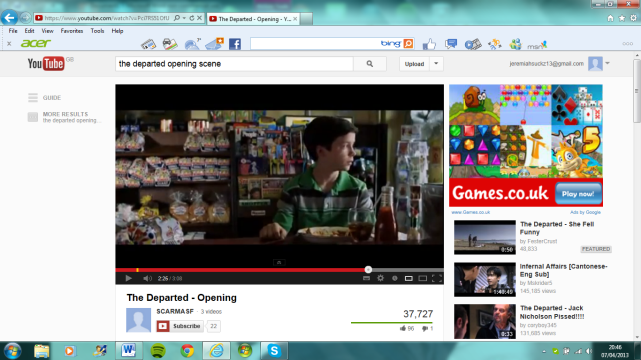
I looked at the first 3.08 minutes of The Departed, I took screen captures of the different shot types and camera angles: 
 
 
The film starts with a black screen, telling the audience
where and when the following scene is going to be set.
 
 
 The next lot of film looks like hand held footage of
first men fighting at a slight high angle eyelevel shot,
then a bus driving by at an eyelevel medium shot which
then pans, more fighting men at same shot as before, a
shot of a post box with NO spray painted on it at a medium
eyelevel shot, a girl on a bus waving at maybe slightly low
angle eyelevel shot, then a shot eyelevel medium shot of
broken glass on the bus which then zooms out to show
a line of buses outside a school, then a pan of people
protesting at an eyelevel medium shot,
then a man giving a door to door interview at a
slight close up eyelevel shot.
There's background sound of what is going on in the shots,
there's also a voiceover from about 6 second onwards, mainly
talking about the past. There is also some type of jazz music
in the background aswell, which starts at abour 28 seconds.
 
This shot has a pan to the right, while zooming in, obviously
showing us where in Boston the scene is set.
 
The next shot has a man walking and the camera panning
and zooming to the left, in some warehouse, possibly showing
us who the main character is.
 
The next shot is a zoom of the building the following scene
will be set in, a diner.
 
This is an over the shoulder shot of the man who is presumably
the man from 2 shots before and also the voiceover. It shows the
assumed main character collecting money from the shop/diner
owner, which can imply he's a type of mobster.
 
The next shot is a medium eyelevel shot of, as we see from
how the following scene plays out, another presumed main
character.
 
It then has a pan of the young waitress walking over to the older
main character, then a close up shot back to the younger character, then
back to the older character.
 
After a medium shop of the shop owner and father of the waitress, there's an
extreme close up of the young boy's face, in a shot-reverse-shot between him
and the older character as they exchange dialogue, then this shot of a medium
eyelevel of the two characters in the same shot, meeting.
 
After close up shots of food, theres this medium eyelevel shot
of the boy staring at the older character as he gives him all this
food collected for him.
 
Then lastly there's a high angle eyelevel shot of the man giving the
boy the food and a comic.
All the while there's been some background sounds layered with slight
rock music from The Rolling Stones, called Gimme Shelter.

The Godfather Analysis

The Godfather
 
 
The Godfather is seen as one of the best films ever made, especially from a technical standpoint, being one of the most quoted and imitated films of all time. it shows as it was nominated for 11 Academy Awards and winning for Best Picture, Best Actor (Marlon Brando), and Best Adapted Screenplay. The Godfather was followed by a pair of sequels, showing how well it was liked.

The film follows the story of Don Vito Corleone (Marlon Brando) and his son Michael (Al Pacino) in the 1940's New York. It starts at the wedding of Corleone's daughter, Connie, to which Michael brings his girlfriend, Kay, and explains the family buisness to her. Later in the film the Don gets shot down, after barely surviving the first assasination attempt Michael saves him from another attempt on his life. Micheal then tries to persuaded his older borther Sonny (James Caan) that he should be the one to take revenge on the men responsible. After Michael murders the men responsible he holes himself up in Sicily, while there he loves and marries a local girl, who later dies at the hand of a Corleone enemy in an attempt to kill Michael. All this happenes while back in New York a gang war erupts, and Sonny gets killed. When Michael returns to New York he gets Kay (His ex from the beginning of the film). The Don recovers and makes peace with his enemies. Michael is then the new Don and then goes to launch a campaign to get revenge on the people who once tried wipe out the family.

It has a single narrative voice told through the main character's point of view (Don Coleone). The storyline is sometimes interrupted, (which can sometimes be confusing and hard to follow), to emphasize important events, like the use of parallel storylines taking place showing Sollozzo’s double dealing with Don Corleone and another family right before the an assassination attempt on Don Corleone. The film is slow, deliberate and precise, reminding us of the head of the Corleone family. There’s plenty from vendettas to power struggles to rising through the ranks to become head of a powerful organization. More than anything, this is Michael Corleone’s (Al Pacino) story. It tells how this youngest son of Don Corleone (Marlon Brando) went from a civilian to the head of his mob family – how he cast aside the promise of a “normal” life for the duty and obligation to safeguard his family. Indeed, “family” is a big part of the film – and a big part of why Michael’s motivations seem so genuine (even if his actions are murderous). Of course, family plays a crucial role in this movie, as it does with many cultures and societies. The family theme is established fromt the first scene  at the wedding, as they are where large extended families come together, its also where the "family buisness" is first intoduced. Throughout the film there's the sence of loyalty, for example when Michael saves his father from the rivals assasination attempt. Overall the film shows that it earned it awards through the acting, music, script and directing.